Lateral Fracking Tracking Technology: Engineering Breakthroughs, Corporate Beneficiaries & Technical Setups
Covered Tickers: $EXE (Expand Energy) • $DVN (Devon Energy) • $FANG (Diamondback Energy) • $LNG (Cheniere Energy) • $MPC (Marathon Petroleum) • $MNR (Mach Natural Resources)
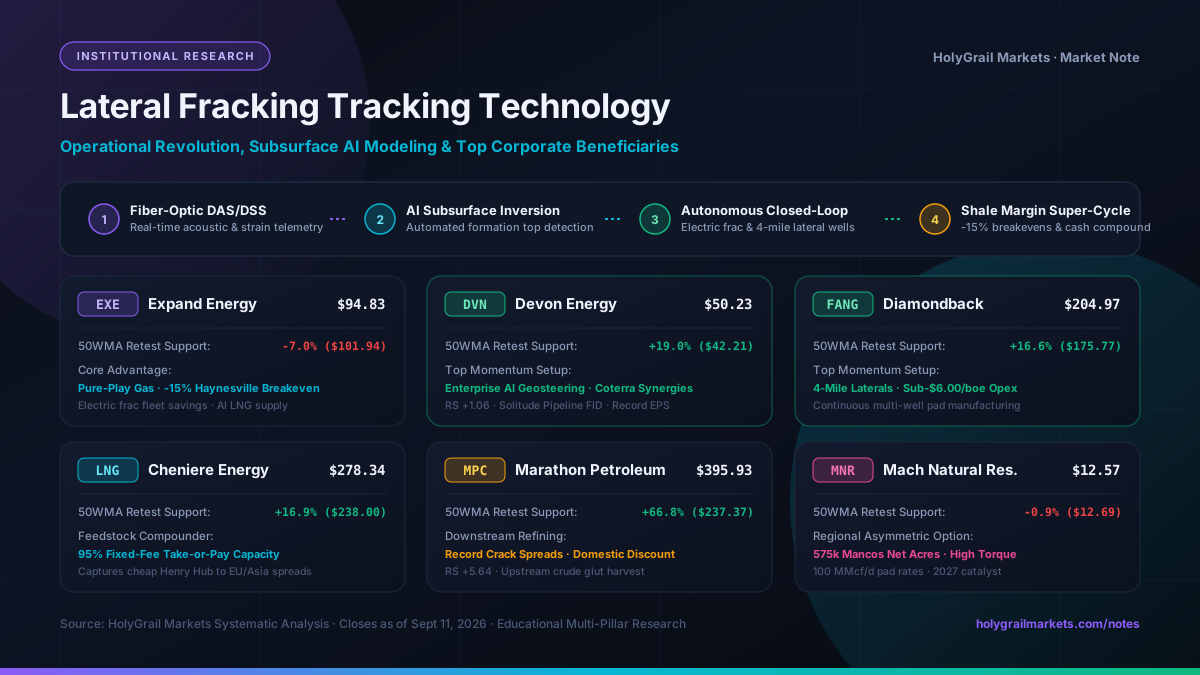
Lateral fracking tracking technology—combining real-time distributed fiber-optic sensing (DSS/DAS), AI-driven subsurface interpretation, and autonomous closed-loop completions—is structurally driving down U.S. shale breakevens and unlocking massive reserve inventory. This operational revolution directly favors low-cost E&Ps (EXE, DVN, FANG), downstream LNG compounders (LNG), and refiners (MPC). Our research evaluates the core technological stack, comprehensive forward valuation multiples, and weekly 50WMA technical momentum structures to identify the highest-conviction 12-month beneficiaries.
### 🎯 Author's TLDR (Medium Term): DVN and FANG Have the Strongest Momentum Opportunity
- Fundamental: Both operators pair sub-$6/boe low costs with high cash margins—Devon ($50.23) is capturing $1B+ in Coterra merger synergies and pipeline catalysts, while Diamondback ($204.97) leads the Permian in 4-mile lateral and trimul-frac efficiency.
- Technical Structure: Both trade cleanly above rising 50-week moving averages with market-beating relative strength (DVN +1.06, FANG +0.87 vs. SPX) and healthy weekly RSIs (57–61)—avoiding the base-building lag of EXE (-7%) and the climactic overbought risk of MPC (+67%).
1. The Basis: What Lateral Fracking Is & The 2025–2026 Tracking Stack
Horizontal hydraulic fracturing ("lateral fracking") is the engineering cornerstone of modern unconventional energy. The process begins by drilling vertically into deep shale formations and turning the wellbore horizontally to extend sideways for 1 to 4 miles through narrow hydrocarbon-bearing rock. Once cased and cemented, high-pressure fluid and proppant (specialized sand) are injected in sequential stages to fracture the impermeable rock matrix and liberate trapped oil and gas.
Historically, operators drilled laterals semi-blindly: they pumped designed volumes of water and sand into each stage, hoping for uniform propagation. In reality, rock heterogeneity, stress shadowing, and perforation friction resulted in dramatic inefficiency—often with less than 60% of frac stages contributing meaningful production.
Over the 2025–2026 cycle, a transformative technological stack has emerged, converting completion operations from static empirical estimation into high-precision, closed-loop subsurface manufacturing:
1. Distributed Fiber-Optic Sensing (DSS & DAS)
Permanent fiber-optic cables cemented along the exterior of wellbore casings now deliver continuous, sub-millimeter quantitative measurement of acoustic vibrations (Distributed Acoustic Sensing - DAS) and strain deformation (Distributed Strain Sensing - DSS). Operators can monitor fracture opening, proppant placement, conductivity evolution, and inter-stage stress shadowing in real time. For the first time, completion engineers can pinpoint exactly which cluster perforations are taking fluid and immediately detect underperforming or wasted stages.2. AI-Driven Subsurface Interpretation
Machine-learning models (incorporating gradient boosted decision trees and deep spatial neural networks) now predict formation permeability with an $R^2 > 0.92$. Concurrently, Embedded Discrete Fracture Models (EDFM) have reduced fracture-parameter calibration error down to 6.8%. Crucially, edge-computed predictive models can forecast proppant screenouts and sand plugging ~30 seconds before they occur with >85% accuracy—providing automated systems ample lead time to throttle pump rates and avert multi-million-dollar wellbore remediation.3. Autonomous, Closed-Loop Completions
The transition from human oversight to machine-governed execution is already operational:- January 2026: Halliburton and Coterra deployed North America's first fully autonomous hydraulic fracturing operation (OCTIV Auto Frac), achieving a 17% increase in stage efficiency and uninterrupted continuous pumping.
- June 2026: Chevron and Halliburton executed closed-loop completions integrating ZEUS IQ electric frac units directly with Chevron's proprietary subsurface algorithms, continuously adjusting pressure, slurry density, and chemical concentrations on the fly.
4. Satellite-Based Frac Tracking & Output Forecasting
High-resolution satellite analytics (led by synthetic-aperture radar and optical monitoring from providers like Kayrros) now track active frac crews and well completion counts across the Permian, Haynesville, and Anadarko basins. When paired with stage-efficiency metrics, satellite frac tracking forecasts basin-level oil and gas production with 91% predictive accuracy—rendering legacy rotary rig counts (which exhibit only ~10% correlation with short-term output) obsolete for institutional allocators.5. Extended 4-Mile Laterals & Simul-Frac / Trimul-Frac Operations
Operators are routinely extending horizontal reaches from 2 miles to 3- and 4-mile laterals (demonstrated at scale by ExxonMobil and Diamondback in the Permian). To maximize crew utilization, operators run simul-fracs and trimul-fracs—fracturing two or three adjacent wells simultaneously from a single multi-well pad, slashing completion cycle times and facility footprint per crew-day.6. Enhanced Chemical Recovery & Surfactants
Nuclear magnetic resonance (NMR) reservoir characterization combined with tailored nano-surfactant "cocktails" (pioneered by Chevron and Devon) significantly reduce interfacial tension within micro-pores, yielding up to 20% higher cumulative hydrocarbon recovery over a well's initial 10 months of production.Strategic Read-Through for Equity Allocators
This engineering convergence structurally compresses breakeven costs by $5 to $10 per barrel of oil equivalent, expands effective inventory on existing acreage, and revitalizes previously marginal formations (such as the Deep Anadarko and San Juan Mancos). Furthermore, prolonged geopolitical tensions across the Middle East have tightened global refining capacity and stimulated LNG export demand, setting up an exceptional macroeconomic runway for differentiated operators.2. The Beneficiaries: Core Five & Regional Leaders
We analyze five core corporate beneficiaries across the upstream, midstream, and downstream value chains, supplemented by the primary regional player unlocking new basin inventory:
1. Expand Energy (NASDAQ: EXE) — The Deepest Value Discount
- Business Profile: Formed via the transformational merger of Chesapeake Energy and Southwestern Energy, Expand Energy is now the largest pure-play natural gas producer in the United States. Its assets span the premier low-cost basins: the Marcellus/Utica in Appalachia and the Haynesville/Bossier in Louisiana/Texas.
- Technology Integration: Direct and proactive. EXE maintains an exclusive partnership with Evolution Well Services for 100% electric hydraulic fracturing fleets. Electric frac integration and extended laterals reduced Haynesville breakevens by 15%, achieving a $225M year-over-year reduction in maintenance capital expenditures.
- Commercial Leverage: Expanding gross margins via a targeted $0.20/Mcf realization premium (~$500M incremental EBITDA over 3–5 years). EXE is strategically situated to feed ~90% of incremental U.S. natural gas demand growth stemming from Gulf Coast LNG terminals and hyper-scale AI data center power demand.
- 👉 Scan Expand Energy ($EXE) in HolyGrail Scanner
2. Cheniere Energy (NYSE: LNG) — The Cheap-Feedstock Downstream Compounder
- Business Profile: The preeminent U.S. liquefied natural gas exporter, Cheniere owns and operates the Sabine Pass terminal (Louisiana) and Corpus Christi terminal (Texas), coupled with extensive pipeline feed networks.
- Technology Integration: Cheniere does not frack wells—it captures the downstream spread. Every efficiency gain in lateral tracking technology keeps U.S. Henry Hub feedgas structurally abundant and affordable. Approximately 95% of Cheniere's liquefaction capacity is contracted under long-term, fixed-fee take-or-pay agreements with creditworthy global utilities, immunizing cash flow from domestic commodity volatility while converting cheap shale gas into premium European and Asian delivery margins.
- Operational Progress: Q1 2026 adjusted EBITDA exceeded $2.3B, prompting management to raise full-year 2026 EBITDA guidance to $7.25B–$7.75B. Bechtel is progressing on Sabine Pass Stage 1 expansion, while Corpus Christi Stage 3 trains 1–6 are ramping smoothly.
- 👉 Scan Cheniere Energy ($LNG) in HolyGrail Scanner
3. Devon Energy (NYSE: DVN) — Merger Synergies, AI Adoption & Mid-Continent Anchor
- Business Profile: A premier multi-basin exploration and production company anchored across the Delaware Basin (Permian), Eagle Ford, Anadarko, Williston, and Powder River basins, augmented by Appalachian Marcellus gas following its landmark merger with Coterra Energy completed in May 2026.
- Technology Integration: Devon presented breakthrough research at IMAGE 2026 co-authored with HXMX, unveiling an enterprise AI automated interpretation platform that identifies geologic formation tops as accurately as seasoned geoscientists. With Coterra's assets fully integrated, Devon operates as the largest publicly traded E&P across Oklahoma's STACK/SCOOP (Anadarko) play.
- Capital Discipline: Delivered record post-2022 quarterly core EPS of $1.57 on $7.42B in revenue. DVN reached Final Investment Decision (FID) on the 2.6 Bcf/d Solitude Pipeline System with MPLX and WhiteWater (securing Delaware basin gas takeaway), while exploring a $4B+ non-core asset monetization in the Eagle Ford and Powder River basins.
- 👉 Scan Devon Energy ($DVN) in HolyGrail Scanner
4. Diamondback Energy (NASDAQ: FANG) — The Purest Technological Operator
- Business Profile: Pure-play Permian Basin powerhouse headquartered in Midland, Texas, operating contiguous tier-one acreage across the Midland and Delaware sub-basins.
- Technology Integration: Diamondback is the industry benchmark for operational execution, leading the Permian in 4-mile lateral completions, trimul-frac simultaneous completions, and autonomous pressure pumping. Contiguous acreage enables multi-well pad manufacturing, driving cash operating costs below $6.00/boe.
- Financial Dynamics: Q2 2026 results outperformed Wall Street forecasts, fueled by strong oil realizations and disciplined unit-cost reduction. Diamondback co-sponsored the Solitude Pipeline FID to eliminate basin flaring risk. Management maintains a prudent macro posture, heavily hedging downside regional price spreads.
- 👉 Scan Diamondback Energy ($FANG) in HolyGrail Scanner
5. Marathon Petroleum (NYSE: MPC) — The Downstream Refining Margin Beneficiary
- Business Profile: The largest independent petroleum refining operator in the United States, commanding 13 refineries across the Gulf Coast, Mid-Continent, and West Coast, integrated with logistics giant MPLX LP.
- Technology Integration: Upstream frac tracking creates structural oversupply of light sweet domestic crude (WTI and Permian grades). Because U.S. crude cannot be exported without transportation costs and infrastructure friction, domestic refiners like MPC acquire feedstock at a structural discount to international Brent and Middle Eastern crudes, driving expanded refining crack spreads.
- Earnings Power: Generated record Q2 adjusted EBITDA of $8.5B ($17.73 EPS vs. $13.95 consensus). Peer-leading refining utilization and crude slate optionality allow MPC to harvest historic crack spreads, although its direct exposure to the technology stack is synthetic rather than operational.
- 👉 Scan Marathon Petroleum ($MPC) in HolyGrail Scanner
6. Mach Natural Resources (NYSE: MNR) — High-Torque Regional Pure Play
- Regional Geography: While Continental Resources was taken private by Harold Hamm, Tom Ward's Mach Natural Resources operates as the purest public proxy for the Oklahoma/Southern Colorado basin corridor. Mach completed ~$1.3B in acquisitions (Sabinal Energy and IKAV San Juan), securing ~575,000 net acres in the San Juan Basin's Mancos Shale (held by production).
- Technology Catalyst: Modern lateral tracking and simul-fracs have unlocked the Mancos: Mach's initial five horizontal Mancos wells yielded a combined rate exceeding 100 MMcf/d, and its Deep Anadarko pad flowed 40 MMcf/d. With Mancos completions deferred to 2027 to prioritize immediate debt retirement, MNR offers patient allocators explosive asymmetric option value on lateral technology expansion.
- 👉 Scan Mach Natural Resources ($MNR) in HolyGrail Scanner
3. Valuation Profile & Multiple Comparison
To separate durable compounders from cyclical value traps, we benchmark each company's forward valuation against sector medians and consensus Wall Street targets (live market data as of the September 11, 2026 close):
| Company Ticker | Stock Price | Market Capitalization | TTM Revenue (YoY) | Trailing P/E | Forward P/E | Dividend Yield | Consensus Wall St. Rating | Consensus 12-Mo Target | Implied Upside | 52-Week Range |
|---|---|---|---|---|---|---|---|---|---|---|
| EXE (Expand Energy) | $94.83 | $22.0B | $12.96B (+97%) | 8.2x | 10.9x | 3.4% | Buy (26 analysts) | $125.30 | +32.1% | $84.99 – $126.62 |
| LNG (Cheniere Energy) | $278.34 | $57.5B | $20.77B (+25%) | 21.1x | 13.4x | 0.8% | Strong Buy (23) | $309.95 | +11.4% | $186.20 – $300.89 |
| DVN (Devon Energy) | $50.23 | $55.3B | $18.78B (+15%) | 10.9x | 9.4x | 2.6% | Strong Buy (27) | $59.86 | +19.2% | $31.47 – $52.71 |
| FANG (Diamondback) | $204.97 | $57.4B | $16.25B (+20%) | 39.0x | 11.1x | 2.1% | Strong Buy (29) | $233.45 | +13.9% | $134.30 – $216.90 |
| MPC (Marathon Petroleum) | $395.93 | $111.2B | $154.2B (+15%) | 13.7x | 11.7x | 1.0% | Buy (19) | $351.67 | -11.2% | $161.93 – $409.11 |
| MNR (Mach Natural) | $12.57 | $2.10B | $1.42B (+65%) | 22.9x | 9.0x | 11.2% | Strong Buy (8) | $17.00 | +35.2% | $10.46 – $15.02 |
HolyGrail Valuation Spectrum Analysis
- Expand Energy (EXE): Trading at $94.83, EXE has rebounded from its $84.99 52-week low but retains +32.1% upside to the average Wall Street target ($125.30). Trading at 10.9x forward earnings, the market continues to underappreciate its dominant low-cost position in both Appalachia and the Haynesville, creating strong risk-adjusted upside.
- Cheniere Energy (LNG): Deserves an infrastructure multiple premium (13.4x forward P/E). With 95% long-term contracted cash flows and terminal liquefaction expansions entering commercial service through 2027, Cheniere functions as an institutional compounding engine. Recent target increases from JPMorgan ($327) reflect steady multiple expansion.
- Devon Energy (DVN): At 9.4x forward earnings and $50.23, DVN offers an attractive valuation floor backed by substantial post-merger synergy realization ($1B+ targeted run rate with Coterra) and portfolio high-grading toward the Permian and Anadarko basins.
- Marathon Petroleum (MPC): Following an aggressive rally up to $395.93 (near its 52-week peak of $409.11), MPC trades at an 11.2% premium above the average sell-side target ($351.67). Operating at peak historical crack spreads, any resolution in international shipping disruptions will compress refining margins, signaling cautious risk/reward at current levels.
3. Technical Structure & Key Levels (Weekly Holy Grail Framework)
Evaluating fundamental value alongside weekly technical trend structure ensures investors enter when institutional capital is actively supporting the price (data computed with live weekly bars through September 11, 2026):
| Ticker | Last Close | 50-Week Moving Average (50WMA) | Distance to 50WMA | Weekly RSI (14) | Mansfield Relative Strength | Setup Classification | Retest Zone Entry Range | Objective Invalidation Floor |
|---|---|---|---|---|---|---|---|---|
| EXE | $94.83 | $101.94 | -7.0% | 47.7 | -1.46 (Base Building) | BASE BUILDING / RECLAIM WATCH | $92.00 – $102.00 | $84.99 |
| LNG | $278.34 | $238.00 | +16.9% | 58.6 | +0.80 (Outperforming) | BULLISH CONSOLIDATION | $245.00 – $275.00 | $236.80 |
| DVN | $50.23 | $42.21 | +19.0% | 60.6 | +1.06 (Strong RS) | POST-BREAKOUT RETEST WATCH | $44.00 – $48.50 | $42.00 |
| FANG | $204.97 | $175.77 | +16.6% | 57.1 | +0.87 (Outperforming) | ESTABLISHED BULLISH TREND | $180.00 – $198.00 | $174.80 |
| MPC | $395.93 | $237.37 | +66.8% | 80.2 | +5.64 (Extended) | OVERBOUGHT / MEAN REVERSION RISK | Extended (>15% above 50WMA) | $236.00 |
| MNR | $12.57 | $12.69 | -0.9% | 45.0 | -0.88 (Inflection) | 50WMA INFLECTION WATCH | $12.00 – $13.50 | $10.46 |
Detailed Technical Breakdown
#### 1. Expand Energy (EXE) — Base Building & 50WMA Reclaim Candidate
- 50WMA Dynamics: EXE is currently trading at $94.83, just -7.0% below its falling 50-week moving average ($101.94). The stock printed a firm double-bottom pivot above its 52-week low of $84.99.
- Momentum Indicators: Weekly RSI (14) has curled upward to 47.7 from deeply oversold levels, showing steady institutional absorption. Mansfield RS is bottoming as volume shifts to accumulation.
- Execution Strategy: Accumulate within the $92.00–$102.00 base-building zone ahead of the 50WMA reclaim. Maintain a disciplined hard stop below the cycle low of $84.99.
- 50WMA Dynamics: Cheniere pulled back cleanly from all-time highs ($300.89) to $278.34, resting in a healthy consolidation phase +16.9% above its upward-sloping 50WMA ($238.00).
- Momentum Indicators: Mansfield Relative Strength (+0.80) confirms sustained multi-quarter outperformance vs. the benchmark S&P 500. Weekly RSI of 58.6 is perfectly positioned for trend continuation.
- Execution Strategy: Optimal low-risk entry between $245.00 and $275.00 on dips. Invalidation is set at $236.80 (weekly close breaking below the 50WMA baseline).
- 50WMA Dynamics: Devon is trading at $50.23, testing multi-month highs near its 52-week peak ($52.71) after breaking out decisively above its 50WMA ($42.21, +19.0%).
- Momentum Indicators: Strong relative strength (+1.06 vs. SPX) and an assertive weekly RSI of 60.6 reflect massive rotational buying following the Coterra merger and Solitude pipeline progress.
- Execution Strategy: Wait for pullback retests toward $44.00–$48.50 rather than chasing at resistance. Strict invalidation floor sits at $42.00.
- 50WMA Dynamics: At $204.97, Diamondback trades comfortably above its 50WMA ($175.77), exhibiting pristine higher-high / higher-low market structure.
- Momentum Indicators: Mansfield RS of +0.87 and weekly RSI of 57.1 show orderly institutional accumulation without speculative excess.
- Execution Strategy: Accumulate on orderly pullbacks toward $185.00–$195.00. Invalidation floor sits at $174.80.
- 50WMA Dynamics: Trading at $395.93, MPC is situated an extreme +66.8% above its 50WMA ($237.37).
- Momentum Indicators: Weekly RSI of 80.2 indicates severe technical overbought conditions. The stock is extended well beyond HolyGrail's maximum recommended 15% retest buffer.
- Execution Strategy: Not actionable for new long exposure. Prudent capital allocators should take partial profits and wait for a multi-month consolidation back toward the 50WMA.
4. One-Year Conviction Ranking & Strategic Rationale
We synthesize technological leverage, balance sheet durability, valuation margin of safety, and weekly technical setup quality into a definitive 12-month conviction ranking:
EXE > LNG > DVN > MNR > FANG > MPC1. Expand Energy (EXE) — Highest-Conviction Undervaluation
- Thesis: EXE offers the most asymmetric risk/reward among large-cap North American producers. Trading at $94.83 with +32.1% upside to average analyst targets ($125.30) and a 3.4% dividend, it provides substantial margin of safety.
- Catalyst Alignment: Electric frac fleets, Haynesville cost reductions, and surging Gulf Coast LNG pipeline feedgas pull establish an unassailable operational tailwind heading into the winter heating and data-center power inflection.
2. Cheniere Energy (LNG) — Best Risk-Adjusted Compounder
- Thesis: The highest-quality corporate balance sheet in the study. Cheniere captures pure downstream technological benefit without upstream geological risk.
- Catalyst Alignment: With +11.4% to consensus ($309.95) and top-tier Wall Street target revisions (JPMorgan $327), ongoing train additions at Corpus Christi Stage 3 provide transparent, visible EBITDA expansion through 2027.
3. Devon Energy (DVN) — Catalyst-Rich Mid-Continent Powerhouse
- Thesis: Trading at only 9.4x forward earnings with +19.2% upside to target ($59.86) and a 2.6% dividend, Devon combines scale with multiple imminent corporate catalysts.
- Catalyst Alignment: Rapid Coterra cost synergies, the commercial rollout of its HXMX artificial intelligence subsurface platform, Solitude pipeline capacity, and an expected $4B+ non-core asset sale provide tangible balance-sheet de-leveraging.
4. Mach Natural Resources (MNR) — High-Torque Basin Expansion Play
- Thesis: Small-cap ($2.1B) value option with substantial torque on modern lateral fracking. Controlling 575,000 net acres across the San Juan Mancos and leading production across Oklahoma's Anadarko basin, initial flow rates confirm top-tier geology.
- Catalyst Alignment: The 2027 Mancos re-acceleration offers immense delayed upside, while an 11.2% distribution yield compensates patient investors.
5. Diamondback Energy (FANG) — Premier Tech Operator with Smaller Discount
- Thesis: The undisputed technical leader in ultra-long laterals and autonomous completions. However, at $204.97, FANG trades within 5% of all-time highs with only 13.9% upside to target ($233.45).
- Catalyst Alignment: While operationally flawless, aggressive production growth guidance and defensive WTI-Brent hedging limit multiple re-rating headroom.
6. Marathon Petroleum (MPC) — Cyclical Peak Margin Caution
- Thesis: Exceptional capital returns and cash generation, but currently trades at an 11.2% premium above consensus targets ($395.93 vs. $351.67 target) and is technically overbought (RSI 80.2).
- Catalyst Alignment: Historical crack spreads are vulnerable to international diplomatic normalization. Lacks direct technological exposure to the lateral completion stack.
5. Risks, Sensitivities & Invalidation Scenarios
Prudent investing requires rigorously stress-testing the thesis against macro and company-specific vulnerabilities:
Macro Commodity Mean-Reversion
- Upstream cash flows and refining crack spreads are partially supported by conflict-driven supply disruptions in the Persian Gulf. Sustained diplomatic de-escalation between the U.S. and regional powers would compress prompt crack spreads and soften crude benchmarks toward marginal production costs ($65–$70/bbl).
- Most Insulated: EXE and LNG (anchored to structural domestic natural gas demand, data center electricity load growth, and long-term liquefaction contracts).
- Most Vulnerable: MPC (direct crack-spread compression) and FANG (pure oil price beta).
Basin Basis & Infrastructure Bottlenecks
- West Texas (Waha) natural gas differentials have periodically traded at negative prices due to localized pipeline congestion. Until the Solitude Pipeline enters commercial service (late 2026/early 2027), producers without contracted Gulf Coast takeaway face regional realizations discounts.
- Mitigant: Devon and Diamondback's ownership stakes in the Solitude system safeguard firm transit.
Company-Specific Watchpoints
- EXE: Reported trailing P/E of 8.2x is flattered by merger accounting; allocators must anchor models strictly to the 10.9x forward operating multiple.
- LNG: GAAP headline earnings can experience mark-to-market derivative noise from Henry Hub/TTF differentials; cash distributable cash flow (DCF) remains the true north metric. Gulf Coast hurricane season presents recurring temporary shut-in risk.
- MNR: High operational leverage and acquisition debt require capital prioritization. The deferral of Mancos completions pushes its primary volume catalyst into 2027.
6. Twelve-Month Catalyst Calendar
| Time Horizon | Milestone / Event | Impacted Companies | Key Metrics to Monitor |
|---|---|---|---|
| Q3–Q4 2026 | Fall Earnings Season & Capital Budgets | MPC, FANG, DVN, EXE | Refining margin sustainability; updated 2027 drill/complete capex guidance |
| Late 2026 | Corpus Christi Stage 3 Midscale Ramp | LNG | Commercial operation dates for trains 1–6; monthly export cargo counts |
| Late 2026 – Early 2027 | Devon Asset Monetization ($4B+) | DVN | Gross transaction proceeds; debt retirement vs. variable share buybacks |
| 1H 2027 | Sabine Pass Phase 1 Expansion | LNG | Bechtel EPC milestones; commercial contracting percentage |
| 2027 | San Juan Mancos Completion Re-Start | MNR, SJT | Re-acceleration of completions; horizontal flow rates on 575k net acres |
| Ongoing | AI Data Center Gas Power PPAs | EXE, LNG, MNR | Long-term dedicated power supply agreements behind-the-meter |
| Ongoing | Geopolitical Supply / Strait Headlines | All Names | Crude benchmark spreads; domestic refining inventory levels |
Live Analysis in HolyGrail Scanner
Track real-time 50-week moving average retests, Mansfield relative strength, and the multi-zone valuation spectrum across all featured energy tickers live in the platform:
- 👉 Scan Expand Energy (EXE) in HolyGrail
- 👉 Scan Cheniere Energy (LNG) in HolyGrail
- 👉 Scan Devon Energy (DVN) in HolyGrail
- 👉 Scan Diamondback Energy (FANG) in HolyGrail
- 👉 Scan Marathon Petroleum (MPC) in HolyGrail
Explore More
- HolyGrail Scanner Platform
- HolyGrail Technical Methodology
- How 50-Week Moving Average Retests Work
- Weekly Market Notes Archive
- Educational Disclaimers
Status Notice: This research analysis was published by HolyGrail Markets on 2026-09-12 (updated with live market closes as of the September 11, 2026 close) for institutional and retail investment education. HolyGrail provides 100% ad-free market intelligence with zero sponsored distractions or paywalled noise. Always define predetermined invalidation floors before deploying capital. Review our Methodology and Disclaimers.