Mansfield Relative Strength: Finding Market Outperformers
Mansfield Relative Strength (Mansfield RS) measures an individual stock's performance relative to a benchmark index (such as the S&P 500) over a normalized timeframe. By comparing the stock's price ratio against its moving average, Mansfield RS generates a zero-centered oscillator that clearly shows whether a stock is actively outperforming or lagging the broader market.
Conceptual Definition
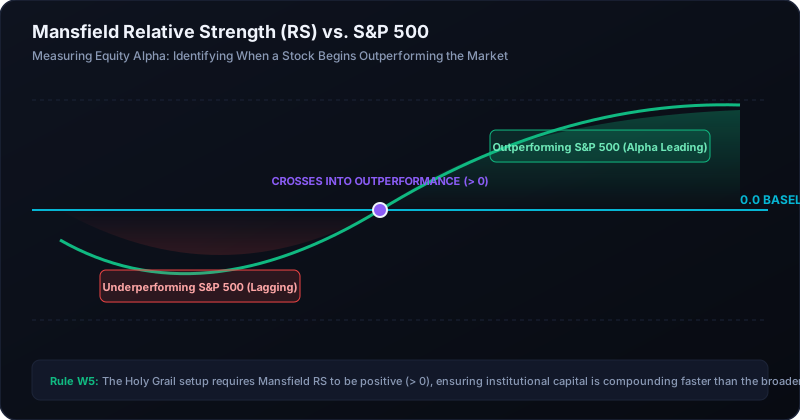
- Mansfield Relative Strength (RS)
- A relative strength calculation pioneered by Stan Weinstein that normalizes the ratio of a stock price to a benchmark index (SPX) relative to its historical moving average, oscillating above zero during periods of institutional outperformance.
During strong bull markets, rising tides lift many boats. However, true market leaders generate alpha by compounding faster than the index. Conversely, when the market pulls back, stocks with high Mansfield RS tend to hold support resiliently.
Interpreting the Reading
- Above Zero (Bullish): The security is compounding faster than the S&P 500.
- Crossing Above Zero: Momentum is inflecting from market follower to market leader.
- Below Zero (Bearish): Even if the stock is rising nominally, it is lagging the benchmark and underperforming institutional capital.
Combining Mansfield RS with the 50WMA
A stock that sits directly in its 50WMA retest zone and demonstrates a positive Mansfield RS curve indicates that buyers are accumulating shares while the stock outpaces the broad market. This dual confluence forms Rule W5 of the Holy Grail Setup.
See also: Risk Disclaimer.